
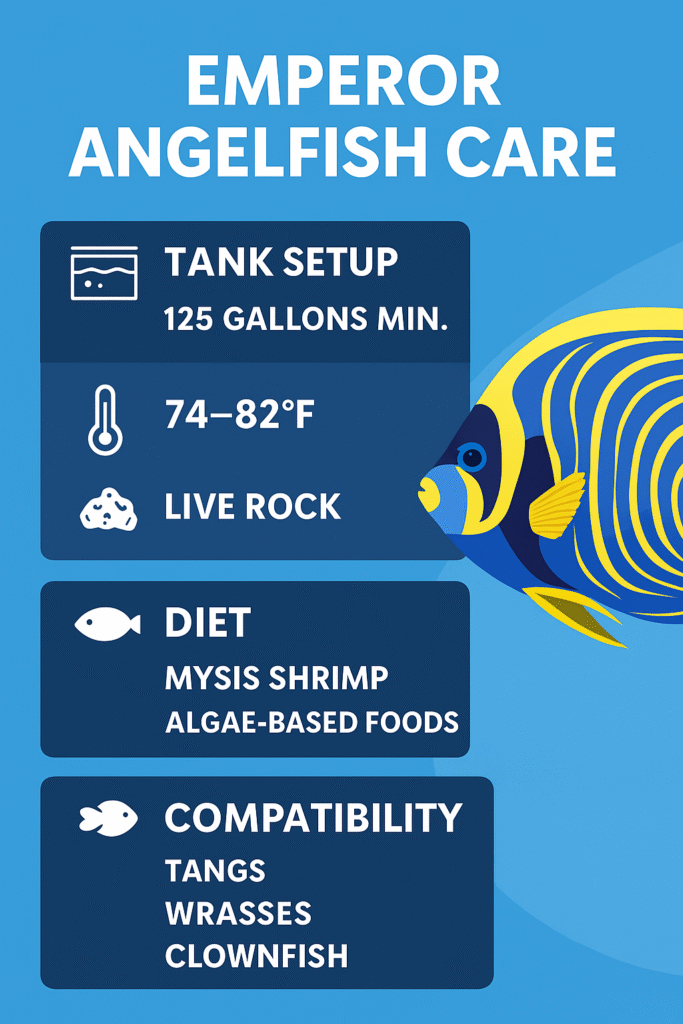
Discover the complete guide to Emperor Angelfish care — from tank setup and diet to ideal tank mates and lifespan. Learn expert tips to keep your Emperor Angelfish healthy, colorful, and thriving in your home aquarium.
If you’ve ever seen an Emperor Angelfish (Pomacanthus imperator), you know why it earns its royal title. With vivid blues, yellows, and sweeping stripes that seem hand-painted by nature, this saltwater beauty can easily become the crown jewel of any marine aquarium.
But make no mistake — keeping one happy and healthy takes more than admiration. The Emperor Angelfish requires a carefully balanced tank environment, a varied diet, and consistent maintenance to flourish.
In this guide, I’ll share everything I’ve learned from years of marine fishkeeping — including how to set up your tank, what to feed them, compatible tank mates, and more — all in simple, beginner-friendly language.
🏝️ Emperor Angelfish Overview
Quick Answer: The Emperor Angelfish is a large, reef-associated saltwater fish known for its striking coloration and strong personality. It requires a spacious, well-filtered aquarium and a diet rich in marine algae and meaty foods.
| Attribute | Details |
|---|---|
| Scientific Name | Pomacanthus imperator |
| Origin | Indo-Pacific reefs |
| Adult Size | 12–15 inches |
| Life Span | 15–20 years (with proper care) |
| Temperament | Semi-aggressive |
| Diet | Omnivore |
| Tank Level | Mid to bottom |
| Minimum Tank Size | 125 gallons |
🌊 Emperor Angelfish Tank Setup
Short Answer: Provide a minimum 125-gallon tank with live rock, stable saltwater conditions, and efficient filtration for your Emperor Angelfish.
Step 1: Choose the Right Tank Size
Emperor Angelfish are large and active swimmers, so space is crucial. A 125-gallon tank is the bare minimum for a single adult, but 180+ gallons is ideal for optimal movement and stability.
Small tanks can cause stress, stunted growth, and aggression — much like trying to fit a lion into a closet. Bigger is always better.
Step 2: Perfect the Water Parameters
Stable water chemistry keeps your angelfish stress-free and colorful.
| Parameter | Ideal Range |
|---|---|
| Temperature | 74–82°F (23–28°C) |
| pH | 8.1–8.4 |
| Salinity | 1.023–1.025 |
| Ammonia | 0 ppm |
| Nitrite | 0 ppm |
| Nitrate | <20 ppm |
Use a reliable refractometer and test kit (like the API Saltwater Master Test Kit) to keep everything in check. To buy this product, click here.
Step 3: Add Live Rock & Hiding Spots
Emperor Angelfish love weaving through caves and overhangs. Live rock not only provides hiding places but also fosters beneficial bacteria — the natural filtration powerhouse of your aquarium.
Try stacking rocks securely and leaving open swimming space in the center.
🪸 Tip: Incorporate macroalgae or artificial reef decor to mimic their natural coral habitat.
🧂 The Nitrogen Cycle: Foundation for Healthy Fish
Before adding your Emperor Angelfish, ensure your tank is fully cycled. Cycling builds up beneficial bacteria that convert harmful ammonia → nitrites → nitrates.
Fast Summary:
- Ammonia from fish waste is toxic.
- Nitrosomonas bacteria convert ammonia into nitrites.
- Nitrobacter bacteria convert nitrites into nitrates.
- Nitrates are removed through water changes and live plants.
👉 For a visual reference, check out this post on the nitrogen cycle.
Cycling usually takes 4–6 weeks. Use a bottled bacteria starter like API Quick Start to speed things up. To purchase a bottle, click here.
🍤 Emperor Angelfish Diet: What to Feed Your Marine Majesty
Quick Answer: A healthy Emperor Angelfish thrives on a mix of marine algae, sponges, mysis shrimp, and formulated pellets.
These fish are omnivores with a particular craving for sponges and algae in the wild. Replicating that diet in captivity is essential for long-term health and color vibrancy.
Daily Feeding Plan:
- Morning: Frozen mysis shrimp or brine shrimp.
- Afternoon: Algae-based flakes or spirulina pellets.
- Evening: Marine angelfish food containing sponge matter.
You can find specialized diets like:
- 🐟 Ocean Nutrition Fish Food – to purchase this fish food, click here.
- 🌿 Hikari Seaweed Extreme Pellets – to purchase these pellets, click here.
Feed 2–3 small meals daily, avoiding overfeeding to keep the water clean.
🐡 Emperor Angelfish Tank Mates
Short Answer: Choose semi-aggressive fish of similar size and avoid other large angelfish to prevent territorial disputes.
Compatible Tank Mates:
- Clownfish
- Tangs (Yellow, Blue Hippo)
- Wrasses
- Hawkfish
Avoid:
- Other large Angelfish (they’ll fight for dominance)
- Small, shy species like gobies or firefish
- Aggressive triggers and puffers
Always introduce your Emperor Angelfish last to prevent them from claiming the entire tank as their territory too early.
🧬 Emperor Angelfish Growth & Life Span
Quick Answer: Emperor Angelfish can live 15–20 years and grow up to 15 inches, requiring a large, stable aquarium for their full life cycle.
Watching your Emperor transition from a dark blue juvenile with white stripes to a majestic adult with yellow and blue bands is one of the most rewarding experiences in fishkeeping.
Maintain consistent water quality, a nutritious diet, and stress-free tank mates, and your Emperor can live for decades.
🧹 Maintenance and Water Changes
Even a “royal” fish needs clean quarters. Perform 20–25% water changes weekly, vacuum debris, and test parameters often.
Use a protein skimmer to remove organic waste and maintain pristine conditions.
Also, replace your filter media monthly and monitor for algae buildup — Emperor Angelfish are sensitive to poor water quality.
🎨 Types of Emperor Angelfish
There’s technically one main species (Pomacanthus imperator), but their appearance changes drastically between life stages.
- Juvenile: Deep blue body with white rings.
- Sub-adult: Transitional with fading rings and emerging yellow.
- Adult: Bold blue and yellow stripes with a dark mask across the eyes.
This transformation takes about 1–2 years — a visual reminder of their majestic evolution.
⚡ Common Health Issues & Prevention
Emperor Angelfish can develop:
- Marine Ich (White Spot Disease)
- Hole-in-the-Head Disease (from poor diet)
- Fin Rot (from dirty water)
Prevention Tips:
- Quarantine new fish for 2–4 weeks.
- Maintain excellent water quality.
- Feed vitamin-rich, varied foods.
Adding vitamin supplements can strengthen immunity and boost color vibrancy.
📋 Summary / Quick Reference Card
| Category | Details |
|---|---|
| Species | Emperor Angelfish (Pomacanthus imperator) |
| Tank Size | 125–180 gallons minimum |
| Temperature | 74–82°F |
| Diet | Omnivore (sponges, algae, mysis shrimp) |
| Temperament | Semi-aggressive |
| Lifespan | 15–20 years |
| Compatibility | Best with tangs, wrasses, clownfish |
| Water Changes | 20–25% weekly |
| Max Size | Up to 15 inches |
❓ Frequently Asked Questions (FAQ)
1. Can Emperor Angelfish live in a reef tank?
Not ideally. They often nip at corals and invertebrates, so they’re best kept in fish-only or FOWLR (Fish Only With Live Rock) tanks.
2. How long does it take for the color change from juvenile to adult?
Usually between 12–24 months, depending on diet, health, and environment.
3. Are Emperor Angelfish hard to care for?
They’re considered moderately difficult, requiring experience with saltwater systems and stable water conditions.
4. How often should I feed my Emperor Angelfish?
Feed 2–3 times per day, using a mix of frozen, flake, and sponge-based foods.
5. Can two Emperor Angelfish live together?
Not recommended. They’re territorial and will often fight unless kept in a huge tank (300+ gallons) with plenty of space and visual barriers.
🌟 Final Thoughts: Raising a True Ocean Monarch
Keeping an Emperor Angelfish is a challenge — but one that rewards patience and dedication with unmatched beauty. Watching it glide through your aquarium, flashing its royal colors, feels like having a piece of the ocean itself in your home.
If you’re ready for the responsibility and can provide the space and stability it needs, the Emperor Angelfish will reign as the centerpiece of your marine world.