
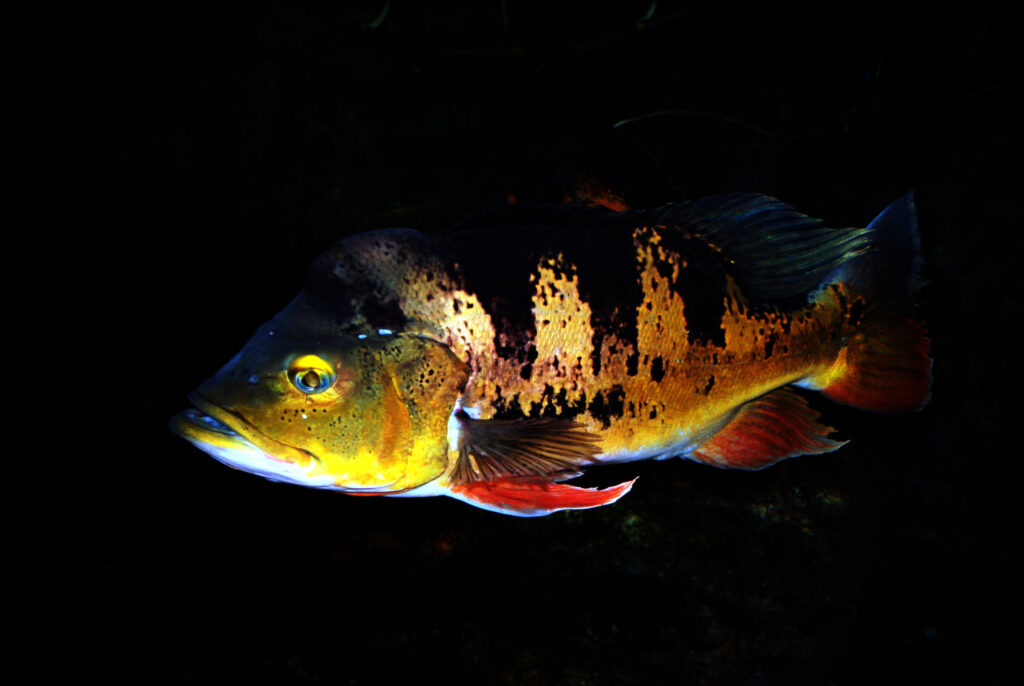
Peacock bass (genus Cichla) are some of the most spectacular predatory cichlids in the hobby, and some of the hardest to house. They are sold as cute 2-inch juveniles, but an adult needs a tank about 10 feet long, a powerful filtration system and a diet of meaty foods. This peacock bass care guide explains what that really means before you buy.
Overview and Appearance
Peacock bass are large, diurnal predators from the Amazon and Orinoco basins and the rivers of the Guianas. Despite the name, they are cichlids and not related to North American bass. The name comes from the eye-like spot (ocellus) at the base of the tail.
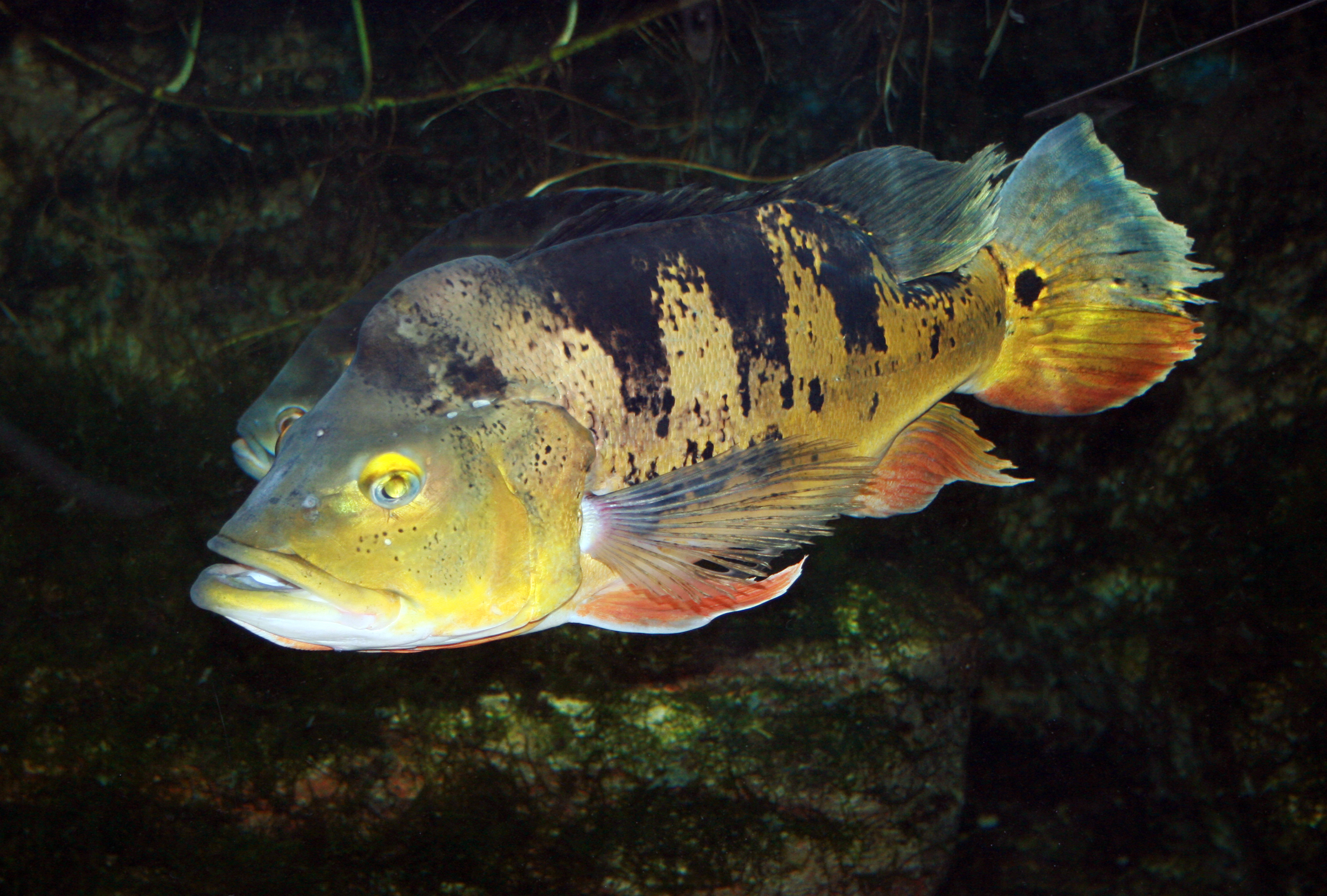
Most species have three broad vertical bars on a yellow, green, grey or gold body, often with orange or red fins. The species you will most often see in the hobby is the butterfly peacock bass (Cichla ocellaris). Taxonomy is messy: about 15 species are recognized, and some may be species complexes, so the fish you are sold may be mislabeled or a hybrid.
Not to be confused with peacock cichlids from Lake Malawi, which are small and unrelated. See our peacock cichlid care guide if that's what you want.
Size and Lifespan
Seriously Fish lists C. ocellaris at up to about 75 cm (30 inches) standard length, and the largest species, the speckled peacock bass (C. temensis), can reach about 1 m (3.3 ft) and 13 kg (29 lb) in the wild. Aquarium fish usually stay smaller, but they still grow fast and get big.
Reliable lifespan data for captive peacock bass is thin, so we won't quote a number. Expect a long commitment, with a fish that outgrows almost every home tank.
Tank Size and Setup
Seriously Fish rates the species as difficult mainly for space: an adult needs a tank of at least 10 x 3 x 4 feet, which is roughly 900 gallons. They are better suited to public aquariums than most homes. Smaller tanks work only for juveniles, and you need a firm plan for the adult. Do not buy a peacock bass if you can't house it long term.
- Swimming room: keep the layout sparse, with large pieces of bogwood and robust plants.
- Filtration: these are big, messy eaters. Seriously Fish suggests external or sump filtration.
- Lid: use a heavy, tight lid. Large predatory fish can leap and strike.
- Equipment: use a heavy-duty aquarium heater with a guard to protect it from a strong fish.
Just a heads up: some of the links in this post are affiliate links, which means I may earn a small commission if you buy through them. But no worries, it is at no extra cost to you. Also, as an Amazon Associate I earn from qualifying purchases.
For a similar big-tank commitment, see our guides to arowanas and oscars.
Water Parameters
Seriously Fish gives these ranges for C. ocellaris:
- Temperature: 75-81°F (24-27°C)
- pH: 6.5-7.0
- Hardness: up to 15 dGH
The species needs steady temperature and pH. With this much waste, test weekly with a liquid test kit and keep ammonia and nitrite at 0 ppm. Frequent large water changes with water conditioner are normal for this kind of tank.
Diet
Peacock bass are piscivores. Seriously Fish recommends meaty foods such as prawn, mussel, lancefish, whitebait and other white fish. Many keepers also offer large carnivore pellets so the diet isn't all frozen seafood.
Be careful with live feeder fish. They can carry parasites and disease into the tank, and a fish raised on live prey can be hard to switch. Wikipedia notes they will even eat their own young when other fish are scarce.
Feed juveniles more often and adults less often, and remove uneaten food to protect water quality.
Temperament and Tank Mates
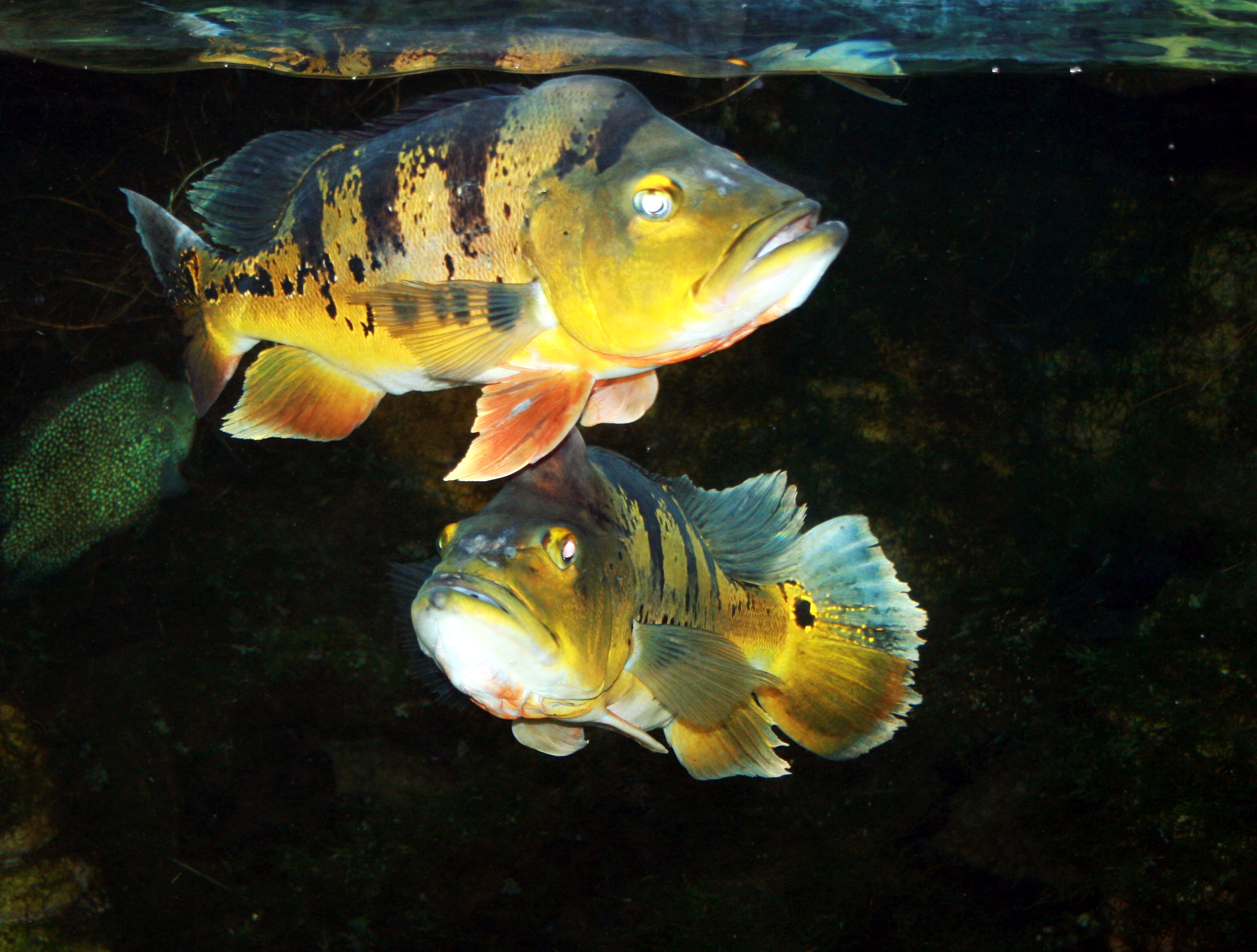
Peacock bass are territorial, moderately aggressive predators that will eat any tank mate small enough to swallow. Seriously Fish says they can be kept in groups or with other large species such as arowanas, stingrays, large catfish and other big cichlids, but only in an extremely large tank, and success is not guaranteed.
- Possible only in huge systems: other large cichlids, big catfish, arowana.
- Avoid: anything small, slow or long-finned, plus invertebrates.
If you prefer a big-fish project in a more manageable footprint, our freshwater stingray guide and red-bellied piranha guide cover other demanding options.
Breeding
Seriously Fish reports only limited breeding in the hobby. In the wild, peacock bass spawn around the rainy season, when many adults, mostly males, grow a hump on the forehead (nuchal hump). Commercial supply comes largely from aquaculture in Asia. Breeding at home is not realistic for most keepers because of the tank size required.
Common Health Issues
Reliable captive-health literature is limited, so these are general risks for large cichlids:
- Water-quality problems: ammonia, nitrite and high nitrates in an under-filtered tank. See our ammonia guide.
- Stress and injuries: from aggression, collisions with glass, or sharp decor.
- Diet-related issues: poor nutrition from a monotonous or low-quality diet.
- Parasites or infections from live feeders: a reason to avoid unquarantined feeder fish.
Quarantine new fish and consult an aquatic veterinarian if a large fish stops eating or looks sick. A quarantine tank for a fish this size is its own challenge, so plan ahead.
Legal and Ethical Issues: Check Before You Buy
Peacock bass are an invasive risk. Wikipedia documents devastating effects when they were introduced elsewhere, such as in Panama's Gatun Lake. Never release one into the wild. Rules on possession differ by region, and Florida, for example, regulates possession and harvest of some species. Check your local fish and wildlife agency before purchasing.
Difficulty Level
Expert. Peacock bass are hardy, but the space, filtration, cost and legal considerations make them one of the hardest freshwater fish to keep responsibly. They suit experienced keepers with a custom tank or public-aquarium-scale setup.
From Aquagram
Explore AquagramTest Account
Hello aquarists!
Dan GL
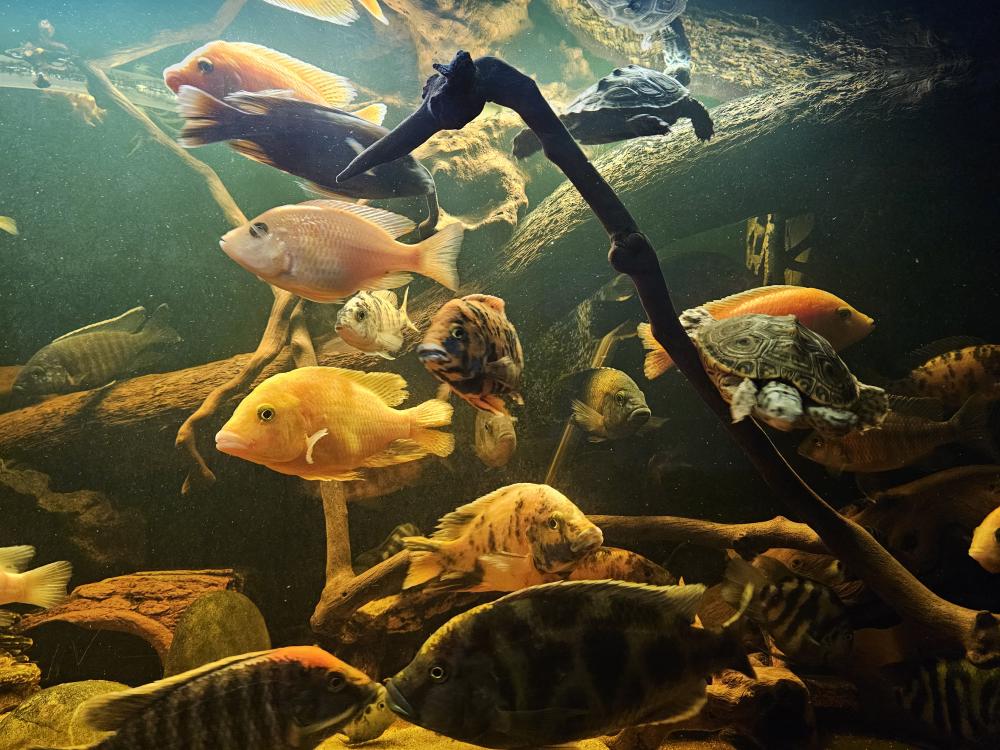
A view of my 125 gallon aquarium. Lots of fish and a few Northern Diamondback Terrapins too! 😁
SwitchTank
Incredible!
Peacock Bass FAQ
How big do peacock bass get in an aquarium?
Species vary, but C. ocellaris can reach about 75 cm (30 in), and the largest species about 1 m in the wild. Plan for a very large adult.
What size tank does a peacock bass need?
Seriously Fish recommends at least 10 x 3 x 4 feet (about 900 gallons) for an adult. Juveniles can start smaller, but they grow quickly.
What do peacock bass eat?
Meaty foods like prawn, mussel, lancefish, whitebait and other white fish, plus quality carnivore pellets.
Can peacock bass live with other fish?
Only with other large species in an extremely large tank. They will eat anything small enough to swallow.
Are peacock bass hard to keep?
They are hardy but demanding because of size, filtration and space. Most people can't house them long term.
Are peacock bass cichlids?
Yes. They belong to the cichlid family and are unrelated to largemouth bass.
Are peacock bass the same as peacock cichlids?
No. Peacock cichlids are small Lake Malawi fish. Peacock bass are huge South American predators.
Is it legal to own a peacock bass?
It depends on where you live. Because they are invasive risks, some places restrict them. Check with local wildlife authorities.
Can you breed peacock bass in a home aquarium?
It is rarely reported. Most aquarium fish come from commercial aquaculture.
Sources and Fact Check
Reviewed 2026-11-20. Google search was blocked during research and the Florida wildlife agency page was unavailable, so the legal section is a general warning rather than a state-by-state guide. Hobbyist forum claims were not used.
- Seriously Fish, Cichla ocellaris: maximum size, 10 x 3 x 4 ft tank, temperature and pH, diet, behavior, limited breeding, difficulty.
- Wikipedia, Peacock bass: genus overview, number of species, spawning season and nuchal hump, aquaculture, diet, and invasive impacts.
Photo credits: Cichla ocellaris at Dvůr Králové zoo by Karelj, public domain, via Wikimedia Commons.
Disclaimer: This article is general information, not veterinary advice. For serious or persistent problems, consult an aquatic veterinarian.