
As an Amazon Associate I earn from qualifying purchases. This post contains affiliate links, which means I may earn a small commission at no extra cost to you.
The flowerhorn is one of the most talked-about fish in the hobby. It has a big forehead hump, wild colors, and a personality closer to a dog than to a typical fish. It is also big, messy, and very aggressive, which is why so many keepers search for flowerhorn care advice after they bring one home.
This guide covers what you need to know before and after you buy: tank size, water, food, tank mates, lifespan, breeding and the problems that come up most.
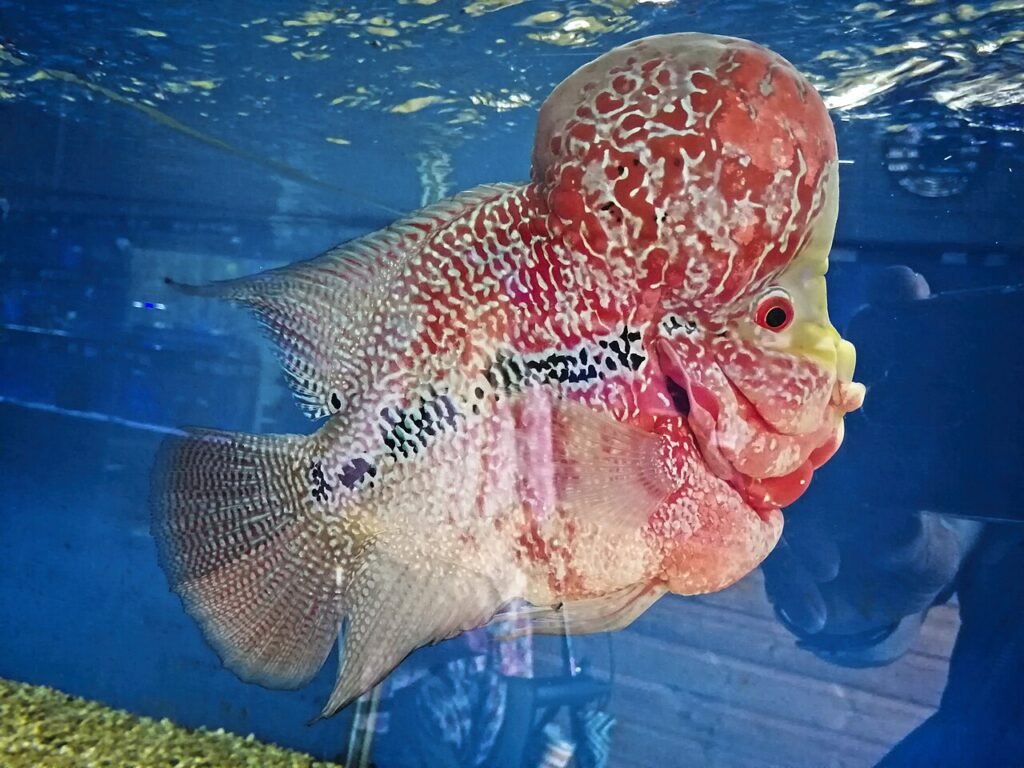
Flowerhorn Overview and Appearance
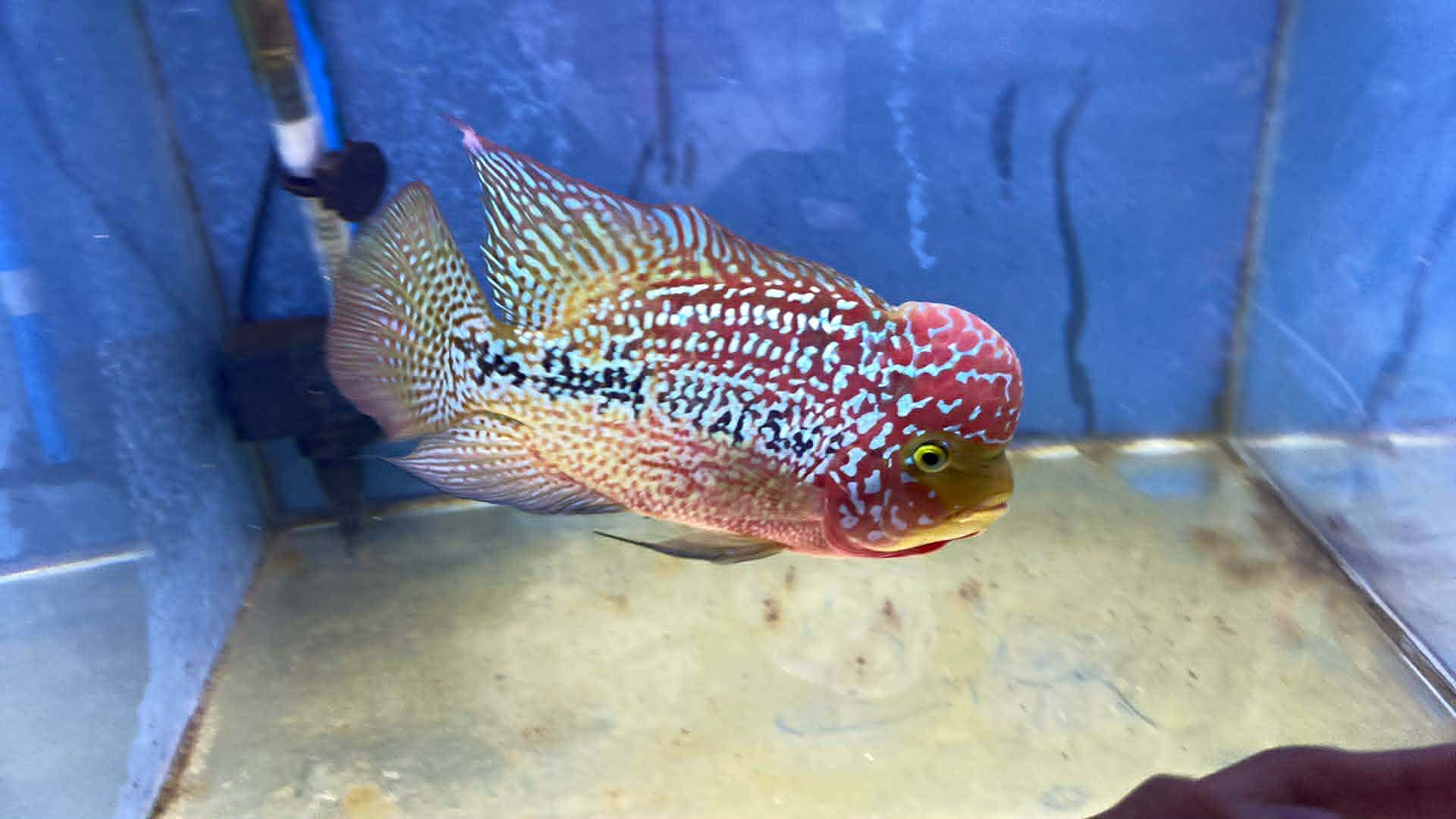
Photo: Markfrancis22 (CC0, via Wikimedia Commons).
Flowerhorns are man-made hybrids, not a wild species. They were developed in Southeast Asia in the late 1990s by crossing several Central and South American cichlids. Because of that, there are many named lines (often sold as Kamfa, Zhen Zhu, Thai Silk, Golden Monkey and others) and no single “correct” look.
What most have in common:
- A prominent fatty bump on the forehead, called the nuchal hump (or “kok”)
- Bright red, orange, pink, white and black coloring
- A pattern of dark blotches along the side, which keepers call the lateral line
- Pearl-like speckling on the body and fins
Males develop larger humps and brighter colors. Many keepers say a flowerhorn will recognize its owner, follow your finger, and even “dance” in front of the glass.
Size and Lifespan
How big does a flowerhorn get? Most reach 10-12 inches (25-30 cm), and large males can grow bigger. How long do flowerhorns live? With good care, 10 years or more is realistic, and 12 is not unusual.
Flowerhorn Tank Size and Setup
The flowerhorn tank size question comes up constantly, and the honest answer is: bigger than you think.
- 75 gallons is a practical minimum for a single adult
- 125 gallons or more is better, especially for a large male that likes to swim and patrol
- Juveniles can start in a smaller tank, but they grow quickly
Setup tips:
- Heavy filtration. Flowerhorns eat a lot and produce a lot of waste. Over-filter with a large canister filter and plan for strong water changes.
- A strong heater. Keep the temperature around 80-85°F (26-29°C) with a reliable aquarium heater.
- Sturdy, simple decor. Fish this size move things around. Secure rocks to the bottom of the tank, not on top of loose sand, and keep plants to a minimum or use heavy, rooted types.
- Tight lid. Large cichlids can jump when startled.
- Sand or smooth substrate. Flowerhorns dig and sift.
A new keeper should read our guide on how to cycle a fish tank before adding any fish.
Water Parameters
Flowerhorns are tough, but stable water still matters, especially with their heavy feeding.
- Temperature: 80-85°F (26-29°C)
- pH: 7.0-8.0
- Hardness: moderate (GH around 8-15 dGH)
- Ammonia and nitrite: 0 ppm
- Nitrate: as low as you can keep it, ideally under 30 ppm
Test the water often with a liquid test kit and plan on 30-50% water changes weekly for an adult in a heavily fed tank.
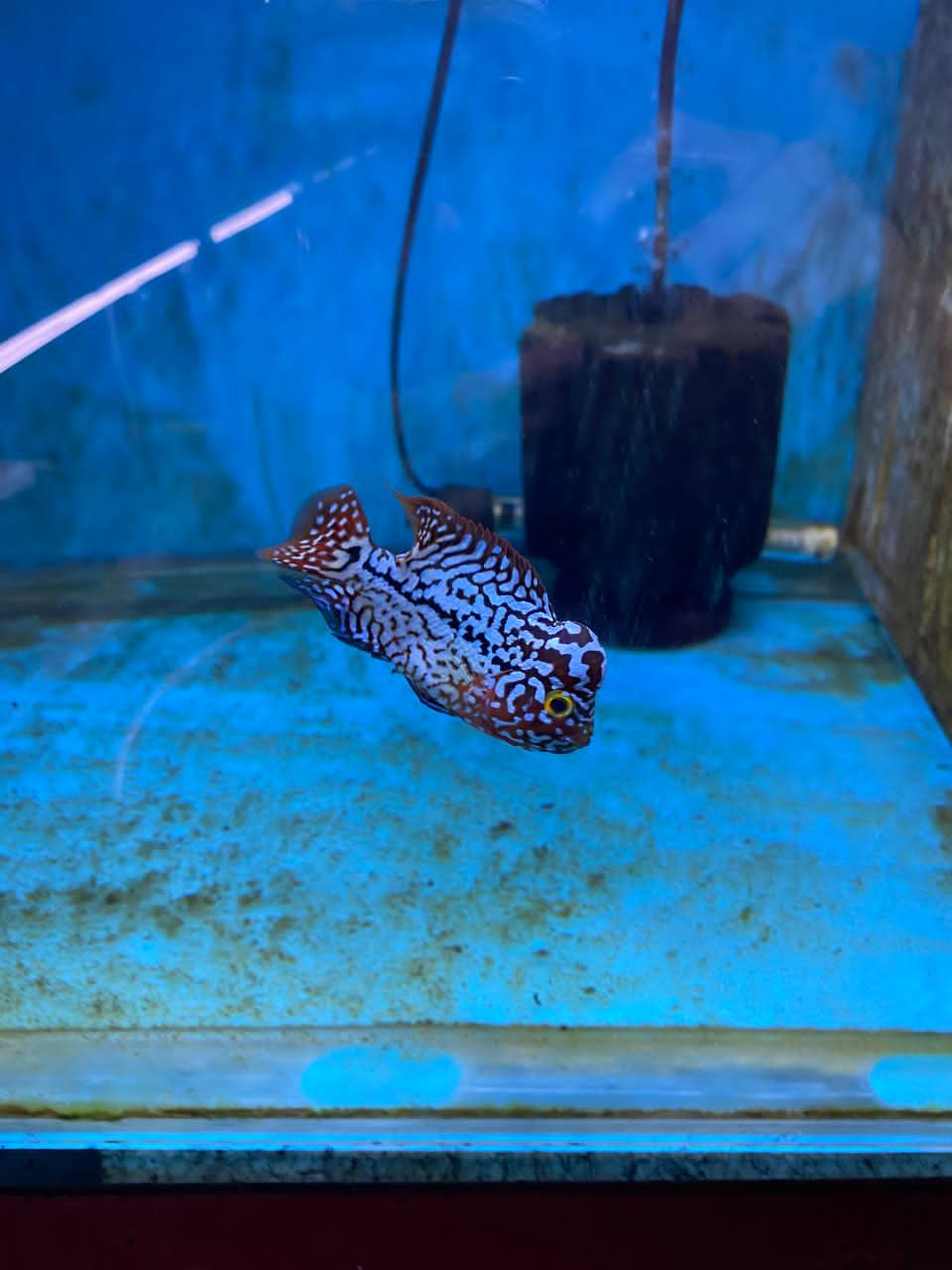
Photo: Markfrancis22 (CC0, via Wikimedia Commons).
Flowerhorn Diet
Flowerhorns are omnivores that lean toward meat. A good diet usually includes:
- A quality cichlid pellet as the staple. Look for a flowerhorn or cichlid pellet made for large, protein-hungry fish. Our guide to African cichlid food explains what to look for in an ingredient list, and the same principles apply.
- Frozen or live treats, such as shrimp, krill, bloodworms and earthworms, a few times a week
- Occasional vegetable matter, like blanched peas
Feed adults once or twice a day, only as much as they finish in a couple of minutes. Overfeeding is the most common reason flowerhorn tanks turn bad.
Things to avoid:
- Feeder goldfish. They can carry disease and are a poor source of nutrition.
- Beef heart and other mammal meat. It is hard for fish to digest and can lead to fatty buildup and bloat.
- Heavy feeding of color-enhancing food without variety. A mix is better.
Temperament and Tank Mates
This is the part that surprises most new owners. Flowerhorns are highly aggressive and territorial. Many keepers house one alone, and that is the safest approach.
Some people try to keep a flowerhorn with other large, tough fish, such as big plecos, large catfish or other robust cichlids, but it often ends badly. Results depend entirely on the individual fish, and you need a very large tank, many hiding places and a backup plan to separate fish immediately.
Tips if you try:
- Add the flowerhorn last or rearrange the tank first to break up territory
- Avoid small, slow, or long-finned fish
- Never keep two males together
- Keep a separate tank ready as a hospital or rehoming option
If you want a similar attitude in a more manageable size, check our guides on the Jack Dempsey, oscar or green terror.
Flowerhorn Breeding
Flowerhorns can breed in home tanks, but it is rarely easy.
- Sexing is mostly done by hump size, color and the shape of the fins
- A pair that is not already bonded will often fight, sometimes to the death
- Eggs are laid on a flat surface, such as a rock or the tank floor, and the parents guard them aggressively
- Many keepers separate pairs with a clear divider before trying to introduce them
- Because many male flowerhorns are reported to be infertile, a pairing can take a long time to produce fry
Breeding is an advanced project. If you are not set up for raising and rehoming dozens of fry, skip it.
Common Health Issues
Flowerhorns are hardy, but several problems show up again and again:
- Hole in the head disease (HITH). Pits on the head and along the lateral line. It is often linked to poor water, stress, and a poor diet, and it needs a water-quality overhaul and a better diet.
- Bloat and digestive problems. Often caused by overfeeding or poor-quality food.
- Ich. White spots, often after stress or a temperature swing. See our guide on what are those white spots on my fish.
- Bacterial infections and fin damage. Aggression and dirty water often cause them. Read about bacterial infections in aquarium fish.
When in doubt, test the water first and then consult an aquatic vet or an experienced cichlid keeper.
Difficulty Level
Intermediate. The flowerhorn is not delicate, but it is large, messy, strong, and aggressive. If you can handle a big tank, heavy filtration and the idea of keeping it alone, it can be a rewarding pet. If you want a peaceful community tank, this is the wrong fish.
Flowerhorn FAQ
What is the best tank size for a flowerhorn?
At least 75 gallons for one adult, and 125 gallons or more is better.
Can flowerhorns live with other fish?
Sometimes, but most are kept alone because of their aggression.
How long do flowerhorns live?
Typically around 10-12 years with good care.
Why is my flowerhorn not growing a hump?
Genetics, age, sex and diet all play a part. Females and some lines develop only a small hump.
Can you keep a flowerhorn in a bowl or small tank?
No. A small container stunts growth, ruins water quality and causes serious health problems.
What should I feed my flowerhorn?
A high-quality cichlid pellet, plus frozen shrimp, krill, bloodworms and the occasional vegetable.
Final Thoughts
A well-kept flowerhorn is an impressive fish with real personality. Give it a large tank, strong filtration, a varied diet and a lot of patience, and it will likely be your pet for a decade.
Do you keep a flowerhorn? Tell us about your fish in the comments.
Disclaimer: This article is general information, not veterinary advice. For serious or persistent problems, consult an aquatic veterinarian.
Image credits: flowerhorn photos by Markfrancis22 (CC0) and Garry Knight (CC BY 2.0), via Wikimedia Commons.