
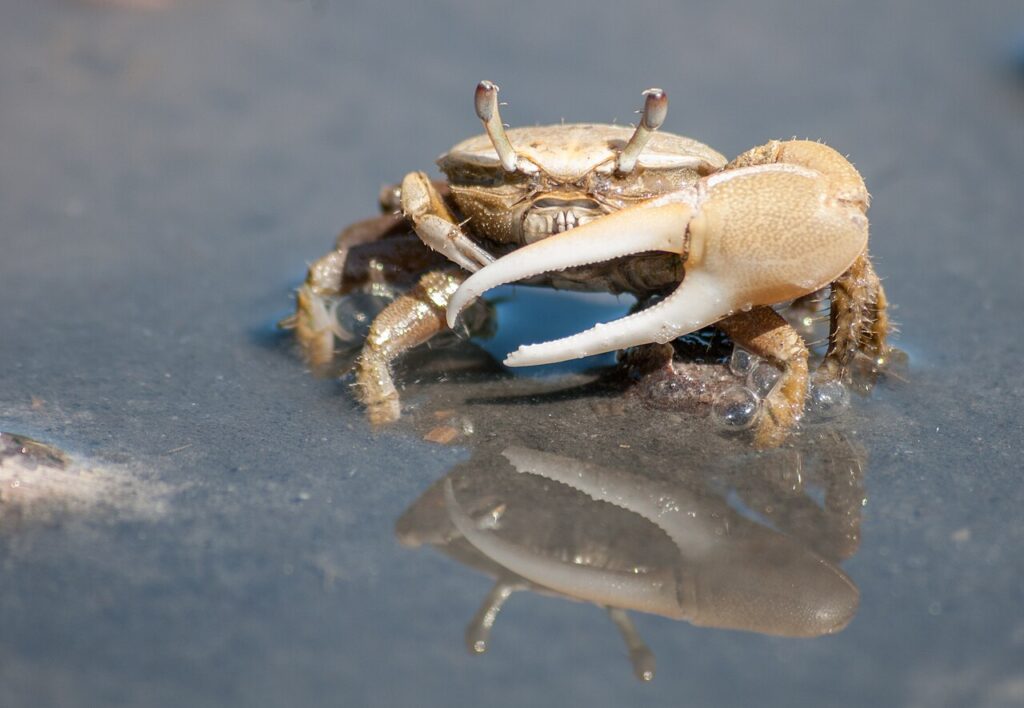
Fiddler crabs are fun to watch, but they are one of the most commonly mis-sold aquarium animals. They are often labeled “freshwater” or sold in a bare tank with no land, and they slowly decline. In nature they live on brackish and salt-water mudflats, not in freshwater ponds. This guide explains how to set up a tank they can actually live in.
Overview and Appearance
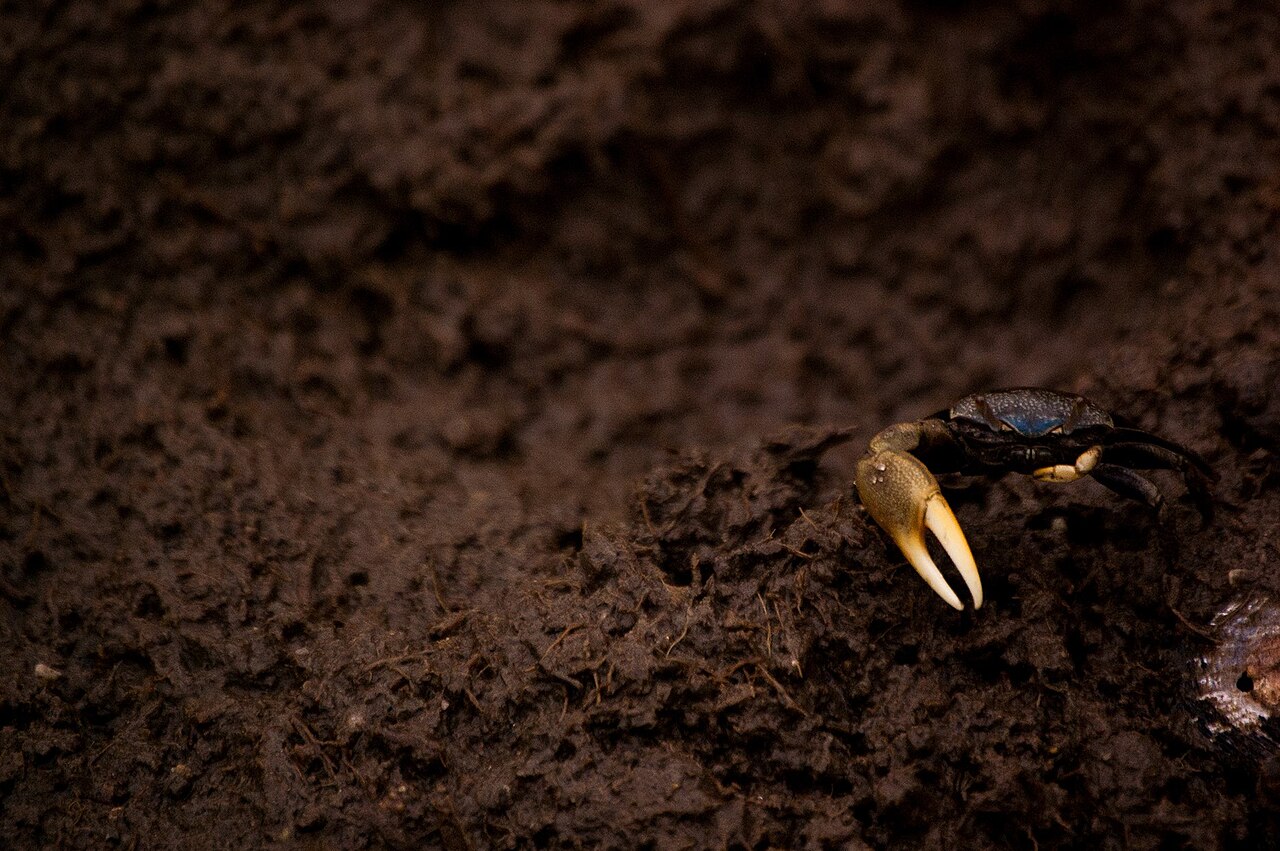
Wikipedia describes fiddler crabs as semiterrestrial crabs with extreme sexual dimorphism: males have one very large claw and one small one, while females have two small claws of equal size. They live on sandy beaches, mudflats, lagoons and mangrove or salt marsh habitats worldwide, with around a hundred species. Pet stores rarely identify the exact species, so you may not know the exact salinity range your crab prefers.
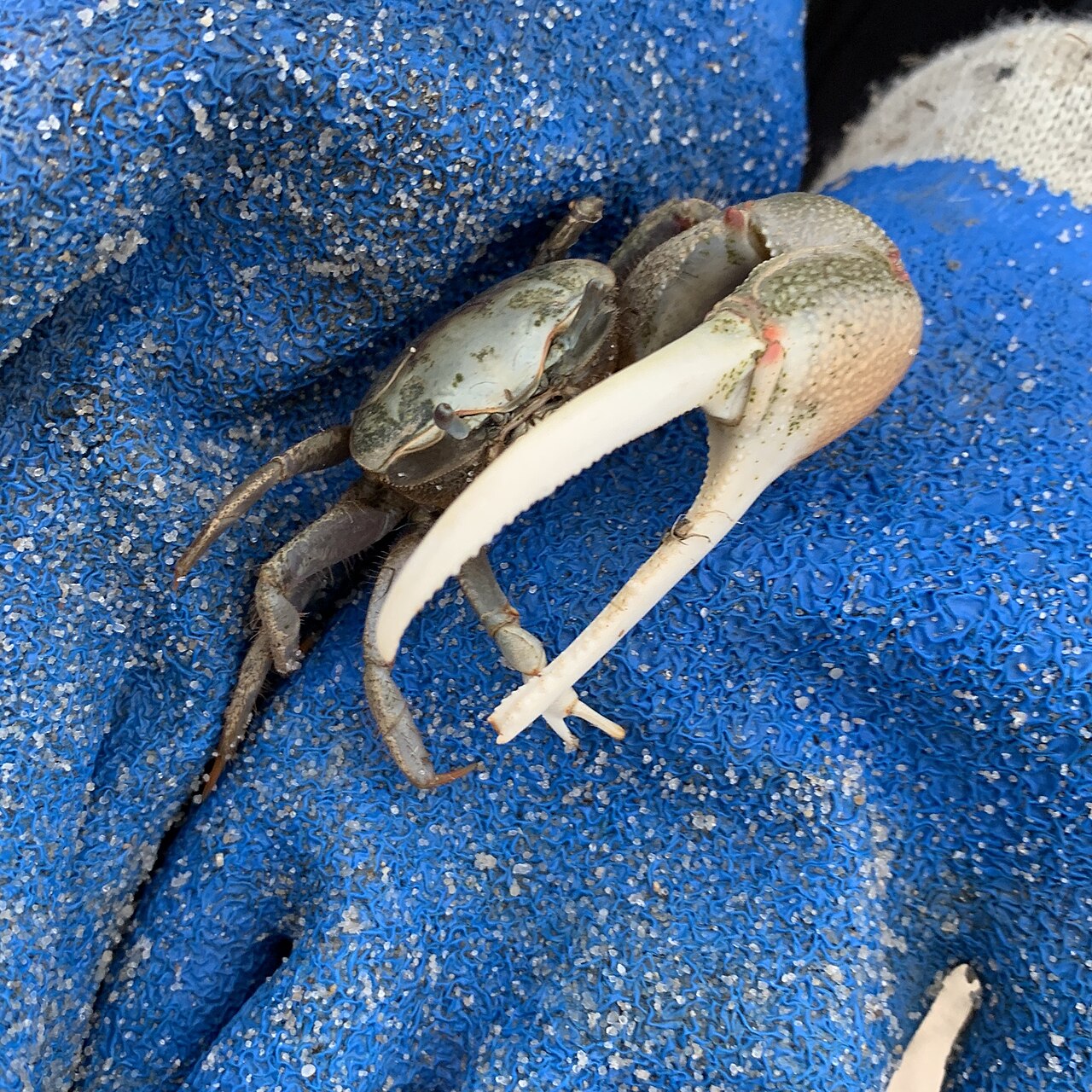
Photos by Wilfredor (CC0), Eric Baratta (CC BY 4.0) and ATleMay (CC BY-SA 4.0) on Wikimedia Commons.
Size and Lifespan
The largest fiddler crab, Afruca tangeri, is just over 2 inches (5 cm) across the carapace according to Wikipedia. Most pet species are smaller. Lifespan data for captive fiddlers is thin. Hobbyists commonly report one to three years, but a lot of crabs die much sooner from poor setups, so treat any number as an estimate.
Tank Size and Setup (Paludarium Style)
A fiddler crab needs both land and water. A 10-20 gallon tank works for a small group.
- Land area: Build a gently sloping bank covering at least half the floor space, with damp sand or sandy mud deep enough to burrow. Marsh fiddler crabs dig burrows about 30-92 cm deep in nature (Animal Diversity Web), so give them as much depth as you can.
- Water area: Shallow brackish water the crab can walk into but not drown in. Always provide a way out.
- Hides: Rocks, driftwood and half-buried flowerpots give them places to retreat, especially after molting.
- Lid: Use a tight lid. They climb and escape through small gaps.
- Humidity and warmth: Warm, humid conditions in the range of tropical aquariums, kept out of direct sun.
- Filtration: Gentle filtration for the water section. A simple sponge filter is often enough.
Just a heads up: some of the links in this post are affiliate links, which means I may earn a small commission if you buy through them. But no worries, it is at no extra cost to you. Also, as an Amazon Associate I earn from qualifying purchases.
Water Parameters: Why Brackish Matters
Fiddler crabs are found in brackish and saltwater environments (Wikipedia). Most hobby guides recommend a specific gravity of roughly 1.005-1.015, a temperature of about 75-82°F and clean water. These are guidelines, not tested numbers, and a few species tolerate a wider range. Measure salinity with a refractometer and mix marine salt with dechlorinated water in a separate bucket, not directly in the tank. See our bumblebee goby guide for a similar brackish setup process.
Diet and Feeding
Wikipedia says fiddler crabs are omnivorous opportunists that scoop up sediment and sift out algae, microbes, fungus and detritus, then leave behind small balls of sand. In an aquarium:
- A staple of quality sinking pellets or flake
- Algae wafers or blanched vegetables
- Occasional brine shrimp, bloodworms or small pieces of seafood
- Feed small amounts and remove leftovers, because uneaten food fouls both land and water.
Temperament and Tank Mates
Fiddler crabs are mostly peaceful but territorial. Males wave their large claw in displays, and the male with the larger claw usually wins disputes, according to Animal Diversity Web. Fights over burrows and mates are normal.
- Group: Keep more females than males, or keep a single male, and provide enough burrow space.
- Tank mates: Avoid fish or shrimp that can be grabbed or that need freshwater. Some brackish fish, such as the figure 8 puffer and green spotted puffer, will eat crabs.
- Compatibility with other crabs: Check species and size before mixing.
Molting
Like all crabs, fiddlers molt to grow. Newly molted crabs are soft and vulnerable and hide until the new shell hardens (Wikipedia). If a crab loses a leg or claw, it can regrow after its next molt. A male that loses the major claw regrows one on the same side. Leave molting crabs alone, do not remove the shed shell for a day or two (they often eat it), and make sure the crab cannot be harassed.
Breeding
Breeding in a home aquarium is rare. Males dig breeding burrows, and the female incubates eggs there. Marsh fiddler larvae go through five planktonic zoea stages and a megalops stage in the wild (Animal Diversity Web). Raising larvae requires brackish or marine water and tiny live foods, so most keepers will not see young survive.
Common Health Issues
- Slow decline in freshwater. The most common problem, usually a salinity and setup issue.
- Dry land or no land. Crabs need damp substrate and humidity.
- Failed molts. Often linked to poor water, low humidity or stress.
- Escapes. Check the lid first if a crab disappears.
- Poor water quality. Even small tanks need regular water changes. See our guide on fish not eating for general troubleshooting steps, and cloudy water for water clarity problems.
Honest Difficulty Level
Moderate for what looks like a beginner pet. The animal is cheap and common, but the setup (brackish water, land area, humidity, secure lid) is more complex than a basic fish tank. Done properly, a group of fiddler crabs is a lively display. Done in a freshwater tank with no land, they usually fail.
Fiddler Crab FAQ
Can fiddler crabs live in freshwater?
Not long term. They are brackish and salt-water animals in nature, and most do poorly in plain freshwater.
Do fiddler crabs need land?
Yes. They are semiterrestrial and need damp, diggable land as well as water.
How many fiddler crabs can I keep together?
A small group in 10-20 gallons is common, with more females than males. Watch for fighting.
What do fiddler crabs eat?
Algae, detritus and small organisms in the wild; in captivity, sinking pellets, algae wafers and small meaty treats.
How long do fiddler crabs live?
Often one to three years in captivity, though properly kept crabs may do better and poorly kept ones far worse.
Do fiddler crabs need a lid?
Yes. They climb and escape easily.
Why is my fiddler crab not moving?
It may be molting or hiding. If it stays unresponsive for a long time, check salinity, temperature and humidity.
Final Thoughts
Fiddler crabs are a small, active, long-term-capable pet when kept as the brackish semi-terrestrial animals they are. Set the tank up before you buy, and avoid any store that tells you they are freshwater only.
Disclaimer: This article is general information, not veterinary advice. For serious or persistent problems, consult an experienced exotic or aquatic veterinarian.
Sources and Fact Check
Reviewed 2026-11-15. Pages actually read:
- Wikipedia: Fiddler crab: habitat, claw dimorphism, largest species about 5 cm, molting and diet.
- Animal Diversity Web: Uca pugnax: burrow dimensions, larval stages, male displays and territorial behavior.
Salinity targets, tank sizes, group sizes and lifespans are common hobby guidelines rather than tested thresholds, and they vary by species. No search engine summary was available at review time, so none of the claims rely on one.